A link can help a page make sense, or it can muddy the waters. That's why anchor text SEO still matters in 2026.
If we use vague phrases or repeat the same keyword again and again, we weaken the signal. The good news is that modern anchor text is simpler than it sounds. We need clear words, a relevant page, and a sentence that fits.
What anchor text SEO means today
Anchor text is the clickable word or phrase in a link. We can think of it like a label on a door. Before we open it, the label should tell us what's inside.
In 2026, search engines read more than the anchor alone. They also look at the sentence around the link and the page it points to. If those three pieces line up, the link makes sense. If they don't, the signal can be ignored. That's why recent thinking around anchor text strategy in 2026 puts more weight on context than on keyword ratios.
Here's the simple version. Linking the words "technical SEO checklist" to a real checklist page is helpful. Linking those same words to a homepage or sales page feels off. Readers notice that mismatch, and search engines do too.
This applies to internal links as well. When we connect related pages with useful anchor text, we help people move through the site with less friction. If we want to tighten site structure, this internal linking SEO guide is a practical next step.
If a reader can't predict the destination, the anchor probably needs work.
The six anchor text types beginners should know
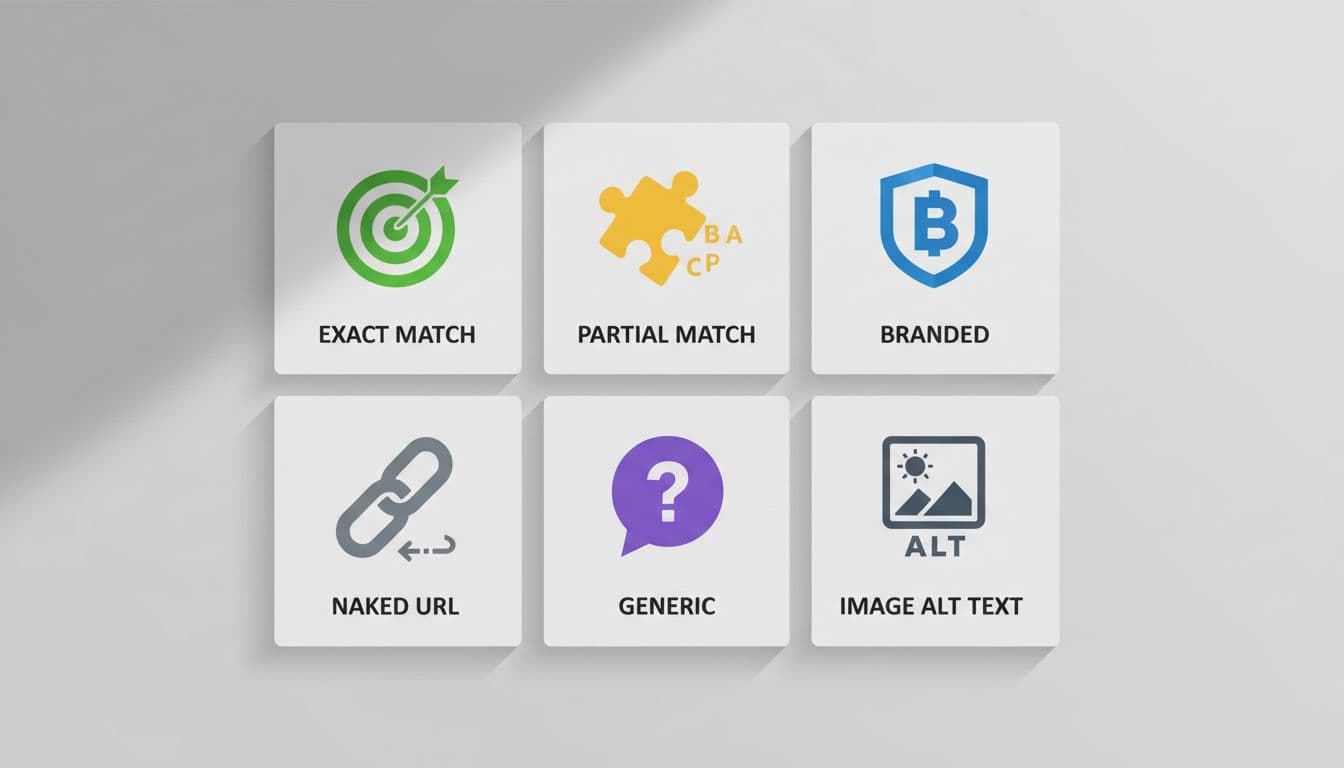
These are the main anchor text types we'll see most often.
| Type | Example | Best use |
|---|---|---|
| Exact match | "anchor text SEO" | Use sparingly, only when it reads naturally |
| Partial match | "beginner guide to anchor text SEO" | Great for clarity with less repetition |
| Branded | "NKY SEO" | Good for trust and natural mentions |
| Naked URL | "brandsite dot com slash guide" | Fine in some citations, but not ideal for readability |
| Generic | "read more" | Weak on its own, better when context is strong |
| Image alt text | "blue trail shoes on a shelf" | Helps when an image itself is the link |
The pattern is clear. Some types give more meaning than others.
Exact-match anchors are not bad by default. The problem starts when we force them everywhere. If every backlink says the same phrase, it looks staged. That's one reason modern anchor text optimization best practices recommend a natural mix.
Generic anchors, like "click here," aren't always useless. In a sentence like "To compare the full numbers, click here," the nearby words add some meaning. Still, descriptive anchors usually serve both readers and search engines better.
Image links deserve extra care. When an image is clickable, the alt text acts as anchor context. That means the alt text should describe the image and, when helpful, hint at the destination. We shouldn't stuff it with keywords. We should write it for accessibility first.
Best practices for anchor text SEO in 2026
The best anchor text feels almost invisible. It fits the sentence, helps the reader, and points to a page that delivers on the promise.
First, we should write anchors around user intent, not around a spreadsheet. If people want a how-to guide, our anchor should sound like a guide. If they need a product page, the link should say so. Strong anchors often come from the same language we uncover during research, which is why a guide to effective keyword research tools can help us find phrases people already use.
Next, we should keep links topically close. A page about local SEO can link to citation tips, Google Business Profile help, or location page advice. It should not jump to a random topic just because the keyword looks tempting. Relevance still wins.
Then, we need variety. Branded anchors, partial matches, natural phrases, and the occasional exact match create a healthier pattern than repeating one term. Search engines have become better at reading meaning, so we no longer need to hammer the same phrase into every link.
A quick four-point check helps:
- The anchor should tell us what we'll get.
- The surrounding sentence should support the link.
- The destination page should match the promise.
- The pattern across the site should feel natural.
Above all, we should stay ethical. Buying piles of exact-match backlinks, swapping low-quality guest posts, or stuffing alt text may create short-term noise. It rarely builds lasting trust. User-first SEO is slower, but it holds up.
FAQ
Does anchor text still matter in 2026?
Yes, but not in the old "keyword trick" sense. It works more like a topic clue, shaped by the words around it and the page it targets.
How often should we use exact-match anchors?
Occasionally is fine. Repeating the same exact phrase too often, especially in backlinks, can look manipulative.
Is “click here” always bad?
Not always. Still, descriptive anchors usually work better because they improve clarity, accessibility, and navigation.
Final takeaway
Good anchor text doesn't try to outsmart search engines. It helps people move with confidence.
If we audit even one page today, we can spot weak anchors fast. Start with links that feel vague, rewrite them with clear intent, and point them to the page that best fits the promise.