
In 2026, thin content SEO is less about word count and more about usefulness. If our pages don't help people, search engines have little reason to rank them.
Google doesn't use a special thin-content penalty for most sites. Still, shallow pages often lose visibility because Google's systems can ignore them, rank them lower, or crawl them less often. That's why a few weak pages can turn into a bigger site problem.
The smarter move is simple, we stop asking how much content we have and start asking how much value each page gives.
What thin content means in 2026
Thin content is any page that adds little original value. Sometimes it's short. Sometimes it's long but empty, like a big box with almost nothing inside.
A 200-word page can rank if it solves the search fast. On the other hand, a 1,500-word page can still be thin if it repeats basics, pads the page with fluff, or says the same thing as everyone else.

We usually see thin pages in a few common places. Tag pages often have one or two posts and no context. Near-empty location pages swap only the city name, so they start to look like doorway pages. Affiliate pages can be weak when they offer no testing, no first-hand notes, and no clear reason to trust the advice. Templated programmatic pages can also fall flat when hundreds of URLs say nearly the same thing.
Thin content is usually a value problem, not a length problem.
That lines up with Google's people-first focus. Search systems want pages that satisfy intent, show real experience, and give readers something useful to take away. Recent third-party reviews of the March 2026 update found that thin affiliate and templated pages were hit hard, while pages with original insight performed better, as seen in Digital Applied's March 2026 content quality analysis.
If we want a stronger frame for judging weak pages, this content quality SEO blueprint pairs well with a thin-content review. It helps us decide whether a page deserves expansion, consolidation, or removal.
How we can run a thin content audit, step by step
A thin content audit doesn't need to be fancy. We only need a clean list of pages and a clear set of decisions.
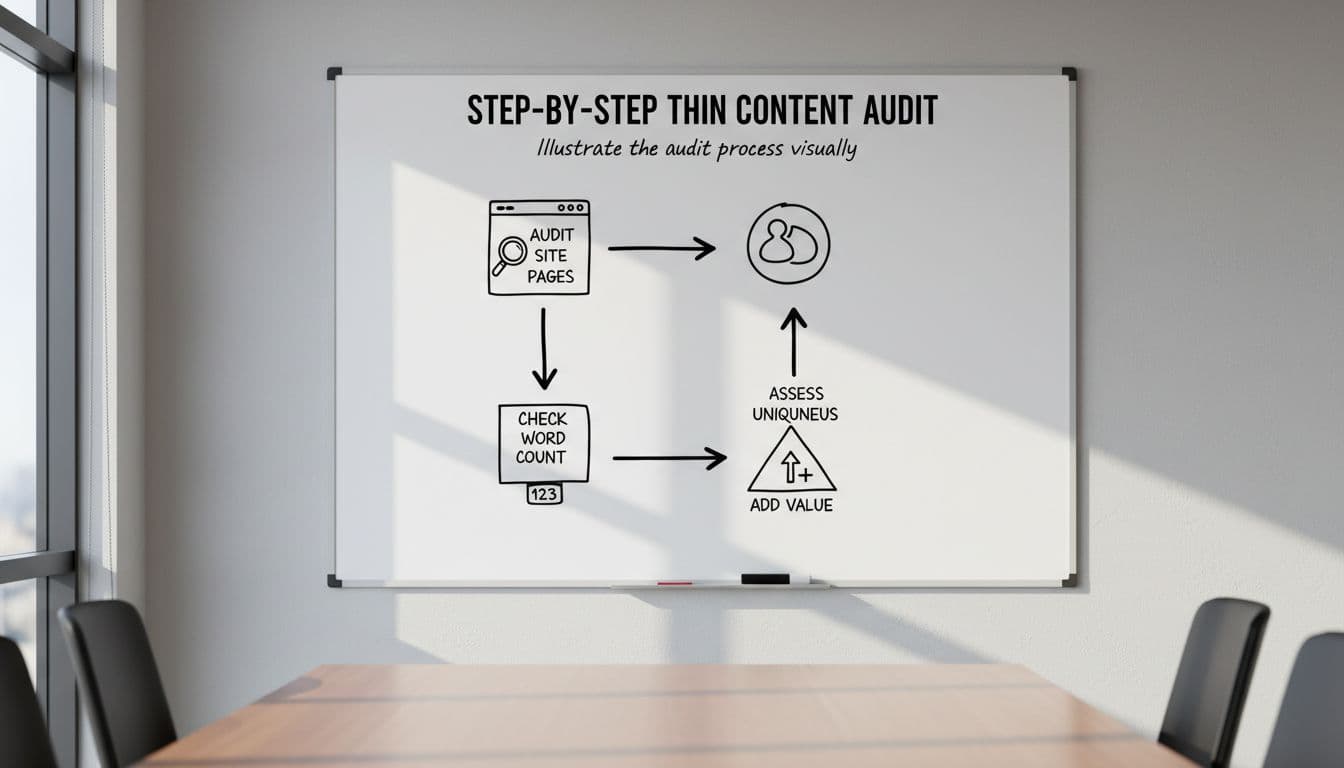
- Start with all indexable URLs.
Export pages from our sitemap, CMS, or a crawler. Then compare that list with Google Search Console. We want blog posts, service pages, category pages, tag pages, and location pages, not only the pages we like. - Flag pages that look risky.
Low traffic is one clue. Very little original copy is another. So are duplicate titles, near-matching headings, weak internal links, and pages with high exits. Word count helps, but it isn't the final test. - Review each page for intent and originality.
We ask, does this page answer one clear search need? Does it offer anything our other pages don't? If the page feels generic, copied, or lightly reworded, it's probably thin. - Pick one action for every weak page.
Usually we improve, merge, redirect, noindex, or delete. A tag page with no value may need noindex. Two similar service pages may need one stronger combined page. A near-empty affiliate post may need real testing, photos, comparisons, and honest pros and cons. - Add substance, not filler.
We improve thin pages by giving them proof and purpose. That can mean first-hand notes, local details, examples, pricing context, screenshots, FAQs, expert quotes, or a clearer next step. If we can't add value, we shouldn't keep the page indexed. - Recheck internal links and site structure.
Good pages need support. Link related pages together, tighten navigation, and make important pages easy to reach. Thin content often gets worse when pages sit alone with no clear place in the site.
Don't pad a weak page with extra words. Either make it better, or fold it into something stronger.
Recovery also takes time. One early March 2026 recovery guide points out that cleanup often needs months of steady work before rankings settle. That's normal, so we should track progress and keep going.
Common mistakes to avoid, plus a quick checklist
The mistakes that keep thin pages thin
The biggest mistake is adding fluff instead of help. If we stretch a page with vague advice, rankings won't improve because the page still doesn't solve the search.
Another common problem is scale without quality. We see this when sites publish 200 city pages, 500 programmatic pages, or dozens of affiliate roundups that all use the same template. The pages look different on the surface, but the value stays flat.
We also get into trouble when we publish AI drafts with little editing, copy maker descriptions, or leave thin archives indexed for years. Search engines don't care whether weak content came from a person or a tool. They care whether the page helps.
A quick thin content SEO checklist we can use
Before we keep a page indexed, we can run this short check:
- Does the page answer one clear search intent?
- Is most of the content original?
- Does it show real experience, proof, or useful detail?
- Is it stronger than similar pages already on our site?
- Would merging it with another page help more?
- Does it have helpful internal links to related pages?
A page that fails several of these checks usually needs work, or it shouldn't stay in search.
Thin content SEO gets easier when we stop treating every URL as an asset. Some pages need expansion, some need merging, and some need to go.
If we do one thing this week, let's audit our lowest-value pages and make a firm choice on each one. A smaller site with better pages will usually outperform a bloated site full of near-duplicates.